
 London Toolkit
  Paris Toolkit
 Visiting the Spanish Steps in Rome
Practical guide including how to get there, walks and tours
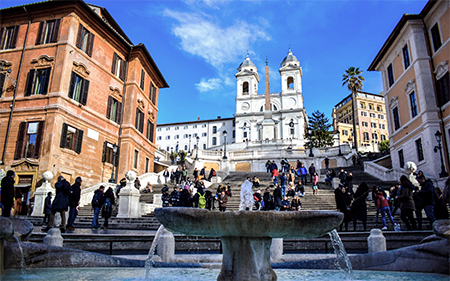
The Spanish Steps are a set of steps dating from 1723, climbing a steep slope between the Piazza di Spagna at the base and Piazza Trinita dei Monti at the top dominated by Trinita dei Monti Church.
The steps are at the eastern end of the old city centre. From the base there is a maze of very narrow lanes crammed full with designer shops waiting to be explored.
The Spanish Steps are still a place for artists, painters and poets to visit. Today, at the top of the Spanish Steps you will find a cluster of artists painting visitor’s portraits.
About the Spanish Steps and nearby in the centre of Rome
The Spanish Steps is a staircase designed in 1723 by Francesco De Sanctis, and funded by a French diplomat Stefano Gueffier.
It was built in order to link the Bourbon Spanish Embassy, and the Trinità dei Monti church, both located above — to the Holy See and Spanish Square below.
The steps are a mix of curves, straight flights, vistas, and terraces. The steps have needed to be restored many times over the years, with the latest restoration being in 1995.
The stairway itself is of 138 steps, if you cannot manage this there is a lift, next to the Metro Station, which will take you to the top of the Spanish Steps.
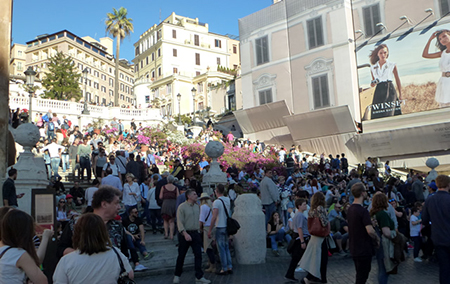
During mid April-May each year the steps are decorated with pink azaleas, making for great photos.
After you have spent your time at the Spanish Steps, the classic tourist option is to head west for the Trevi Fountain and perhaps after that the Pantheon.
The way is sporadically signposted, but a good map is recommended. This walk is so full of interest that getting lost in the maze of narrow streets and alleys is almost a bonus.
See our page for a walk covering Spanish Steps and Trevi Fountain.Don't sit on the steps!
The Spanish Steps are popular with tourists and locals during the spring and summer, where they can get very crowded. As of 2019 you are no longer allowed to sit on the Spanish Steps.
Fines have been introduced to enforce this, to protect this UNESCO site, as increasingly there was damage done to the marble. Laws have been in place for some time banning visitors from eating whilst sitting on the steps; now if seen doing so the fine is hundreds of euros. You have been warned!
What is at the Spanish Steps?
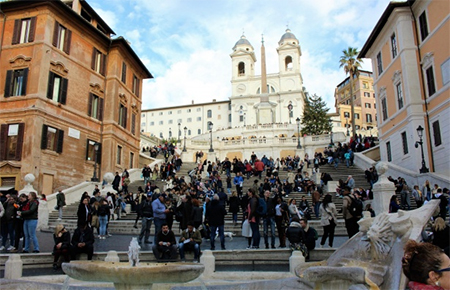
Trinità dei Monti and Obelisco Sallustiano
The Trinità dei Monti is the 16th century French church (with later Italian Renaissance architecture) located at the top of the Spanish Steps. From here you have fine views over the city of Rome.
The Gothic church with a Renaissance facade has two bell-towers. Inside, several paintings decorate the different chapels. Among them are two works by Daniele da Volterra, a pupil of Michelangelo.
The Obelisco Sallustiano stands in front of the church, moved here in 1789. It is a Roman obelisk in imitation of Egyptian ones. The hieroglyphs were copied from the obelisk on the Piazza del Popolo.
John Keats Museum
In the piazza, at the corner on the right as one begins to climb the steps, is the house where English poet John Keats lived and died in 1821. It is now a museum dedicated to his memory, full of memorabilia of the English Romantic generation.
Fountain of the Old Boat/ Fontana della Barcaccia
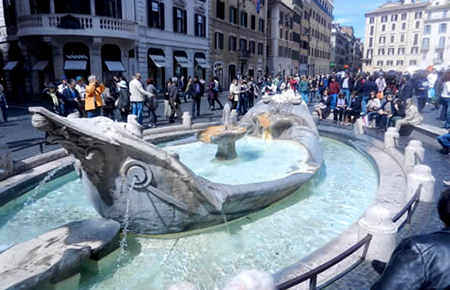
In the piazza at the bottom of the Spanish Steps is the 17th century Fountain of the Old Boat (Fontana della Barcaccia), spouting water as she sinks. The story behind the ship is that the River Tiber often flooded before the city walls were built and in 1598 there was a particularly bad flooding and the Piazza di Spagna was flooded up to a meter. Once the water withdrew, a boat was left behind in the square.
Babington's Tea Room and Restaurant
To the left of the Steps, the classic Babington's Tea Room, is an English Tea Room, founded in 1896, by two English residents Isabel Cargill and Anna Maria Babington. Babington’s offers a wide selection of teas and pastries, as well as main meals, in an elegant setting, with waiters in traditional English attire. Open 10am to 9.15pm.
Via dei Condotti
At the foot of the Spanish Steps the area is of upmarket chic, with an endless supply of small boutique designer shops and a wide range of restaurants and bars. The Via dei Condotti facing the Spanish Steps is where you want to go if you want to shop for Armani, Prada, Versace, Dolce and Gabbana or Gucci. This is not only one of the richest streets in Italy but also one of the best for shopping in Rome.
Behind the Spanish Steps at the top of the steps is an area where you find some of the finest and most expensive hotels in Rome, including The Inn, a member of the small luxury hotels and listed as a national monument.
Getting to the Spanish Steps

By Metro take Linea A (red line) and exit at Spagna. The station is right next to the Spanish Steps.
Rome city buses are too big to negotiate the narrow streets around the Spanish Steps, plenty of buses go to Barberini or Piazza del Popolo / Flaminio about a 10 minute walk away.
There are a myriad of Rome hop on, hop off bus operators, all of which will not stop at the Spanish Steps itself as the buses are too large, but will stop within a 10-minute walk.
A classic Rome walk is to start at the Spanish Steps and end at Piazza Navona visiting the Trevi Fountain and Pantheon on the way.
Free self-guided walks from/to Spanish Steps
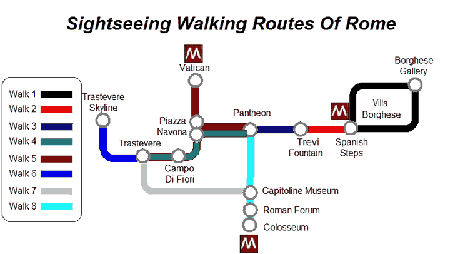
There really is only one way of exploring the ancient city centre of Rome and that's to walk.
Not only is walking the most practical way of visiting all the sights in the ancient city centre its also by far the most rewarding way.
For those who want to explore at their own pace then we have a few free reference walks that connect some of the most famous sights visitors want to see on their visit to Rome. Pick-up a good guide book that can explain what you are seeing and you have the recipe for a great independent adventure.
Free self guided walk - Spanish Steps to/from Trevi Fountain
Professional walking tours - Pantheon, Piazza Navona, Trevi Fountain and Spanish Steps
If you wish to visit the Spanish Steps and other famous Rome buildings on a professional guided walking tour rather than wandering at your own pace with a guide book then one is available.
You stroll through Rome's picturesque cobblestone alleyways and discover some of the world's most famous sites, including the Pantheon, Piazza Navona, Trevi Fountain and the Spanish Steps. You'll travel through time and admire Rome's must-see art and architecture, all in a single afternoon!
Because of the maze of narrow streets ad alleys its not possible to do anything like this tour using a vehicle. Walking is really the only way to explore the ancient centre of Rome.

ANCIENT ROME WALKING TOUR
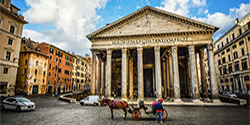
• Visit Spanish Steps,Trevi, Piazza Navona and Pantheon • Small group tour • Led by local guide • Enjoy a home-made Italian gelato/ cappuccino/hot chocolate • Option to add on Colosseum/ Roman Forum + Palatine Hill
Hotels near the Spanish Steps
For a selection of recommended hotels near the Spanish Steps see our dedicated page.
MOST POPULAR ROME TOURS 2024